 1
Dec,2025
1
Dec,2025
Medicare Lift Chair Cost Calculator
How This Calculator Works
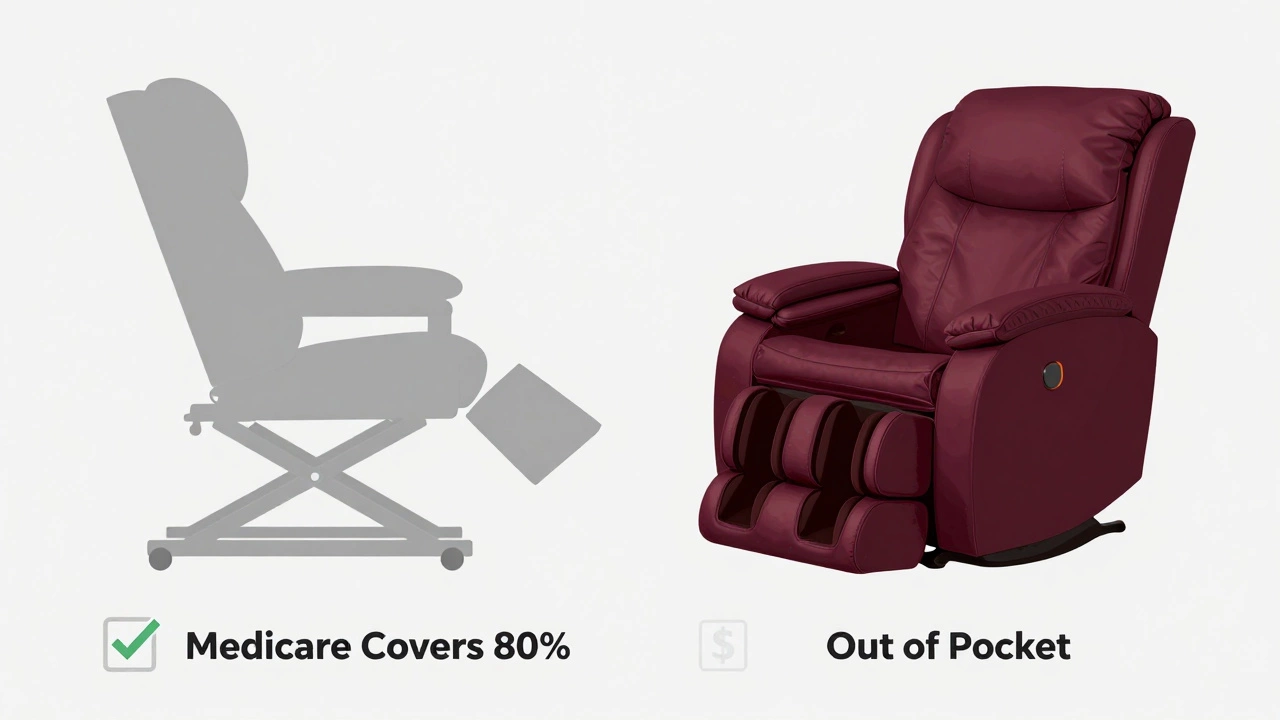
Medicare covers 80% of the approved lift mechanism cost ($300-$500), not the entire chair. Your out-of-pocket cost includes 20% of the lift mechanism plus the full price of non-covered portions.
Note: This assumes you've met your Part B deductible. If not, you'll also need to pay your deductible amount.
Your Estimated Costs
Medicare Coverage:
My Out-of-Pocket:
Non-Covered Chair Portion:
Total Cost:
Medicare doesn’t pay for a lift chair the way you might expect. It won’t cover the full cost, and it won’t pay for the reclining or massage features you see advertised. But here’s the truth: if your doctor says you need a lift chair because you have severe mobility issues, Medicare Part B might pay for part of the lift mechanism - and only that part.
What Medicare Actually Covers
Medicare treats lift chairs as durable medical equipment (DME), not furniture. That means they only pay for the mechanical lift system - the motorized base that helps you stand up and sit down. The chair part - the cushions, fabric, armrests, recline function - is considered a non-covered item. You’re paying for that yourself.
Let’s say you buy a lift chair that costs $1,200. If the lift mechanism is valued at $400 by Medicare’s pricing schedule, Medicare will pay 80% of that $400, which is $320. You’ll pay the remaining $80, plus any deductible you haven’t met yet. The other $800 for the rest of the chair? That’s all out of pocket.
This is where people get confused. You see ads saying “Medicare covers lift chairs,” but they never mention the fine print. The coverage is narrow. Only the lift function qualifies. If your chair has heat, massage, or multiple recline positions, those features are ignored by Medicare. They don’t add to your reimbursement.
How to Qualify for Coverage
Not everyone qualifies. Medicare has strict rules. You need:
- A written order from your doctor stating you have severe arthritis of the hip or knee, or a neuromuscular disease that makes standing up from a regular chair extremely difficult.
- Proof you can’t stand up from a standard chair without help.
- Confirmation you’re able to walk once standing - meaning the lift chair isn’t being used as a wheelchair replacement.
- Buying the chair from a Medicare-approved DME supplier.
If you skip any of these steps, you won’t get reimbursed. Many people buy chairs online from Amazon or Wayfair, assume they’re covered, and then get denied. That’s because those retailers aren’t enrolled in Medicare. You must go through a supplier who bills Medicare directly.
Why Medicare Only Pays for the Lift Mechanism
Medicare’s goal is to improve mobility and prevent falls - not to buy comfort. The agency looks at medical necessity, not lifestyle. A standard recliner with no lift function costs $300-$600. A lift chair with the same frame but added motorized lift costs $800-$2,000. Medicare sees the difference as a medical device, not a luxury upgrade.
Think of it like this: if you need a walker, Medicare pays for the frame and wheels. It doesn’t pay for the padded handgrips or the built-in seat. Same logic applies here.
What You’ll Pay Out of Pocket
Your total cost depends on three things:
- How much Medicare approves for the lift mechanism (usually $300-$500)
- Whether you’ve met your Part B deductible ($257 in 2025)
- Whether you have supplemental insurance
If you’ve already met your deductible, Medicare pays 80% of the approved lift cost. You pay 20%. If you have a Medigap plan, it might cover that 20% - meaning you pay nothing. If you don’t, you’re stuck with the full 20% plus the rest of the chair’s price.
For example:
- Lift chair total: $1,400
- Medicare-approved lift portion: $420
- Medicare pays 80%: $336
- Your 20% share: $84
- Non-covered chair portion: $980
- Your total out-of-pocket: $1,064
That’s not cheap. But for someone who can’t stand without help, it’s still better than paying $1,400 with zero help.
Where to Buy and How to Get Reimbursed
You can’t just buy a lift chair and submit a receipt. Medicare doesn’t reimburse after the fact. You must go through a Medicare-enrolled DME supplier. These suppliers handle the paperwork, bill Medicare, and collect your portion.
To find one:
- Go to Medicare.gov and use the “Find a Supplier” tool.
- Search for “durable medical equipment” and your zip code.
- Call and ask: “Do you bill Medicare for lift chairs?”
- Confirm they’ll accept your doctor’s order and handle the claim.
Some suppliers offer free delivery and setup. Others charge extra. Always ask about fees upfront.
Never buy from a store that says, “We’ll help you get Medicare to pay.” That’s a red flag. Only suppliers enrolled in Medicare can legally bill them.

Alternatives If Medicare Won’t Cover It
If you don’t qualify for Medicare coverage, or your claim is denied, here are other options:
- State Medicaid programs - Some states cover lift chairs for low-income seniors if they meet medical criteria.
- Veterans Affairs - If you’re a vet, VA may cover a lift chair through their DME program.
- Charities - Organizations like the Salvation Army or local Area Agencies on Aging sometimes offer grants or used equipment.
- Medical equipment rentals - Some suppliers rent lift chairs for $50-$100/month. Good for short-term needs.
- Payment plans - Many DME suppliers offer 0% interest financing over 6-12 months.
Don’t assume you’re out of luck if Medicare says no. There are other paths - but you have to ask.
Common Mistakes People Make
Here’s what goes wrong most often:
- Buying from Amazon or Walmart - Medicare won’t pay for purchases from non-approved retailers.
- Choosing a chair based on features - Heat, massage, and multiple recline positions don’t help your claim.
- Not getting the doctor’s order before buying - If you buy first, Medicare won’t retroactively approve.
- Assuming all lift chairs are the same - Medicare only covers specific models that meet their technical standards.
- Not checking if your doctor accepts Medicare - If your doctor doesn’t bill Medicare, your order won’t either.
The biggest mistake? Waiting until you’re in pain to act. If you’re struggling to get up from your chair now, talk to your doctor. Get the order early. That way, when you’re ready to buy, you’re covered.
Final Thoughts
Medicare doesn’t pay for lift chairs like it pays for insulin or physical therapy. It pays for a small, specific part of the chair - the part that helps you stand safely. The rest? You pay. But that $300-$500 reimbursement can make a huge difference in your monthly budget.
Don’t let the marketing hype trick you. Lift chairs aren’t luxury items. They’re medical tools. And if you need one, you’re entitled to some help. Just know the rules. Follow the steps. And don’t buy until you’ve talked to your doctor and a Medicare-approved supplier.
For most people, the real value isn’t in the recline. It’s in standing up without help. That’s what Medicare sees. And that’s what matters.
Does Medicare cover the entire cost of a lift chair?
No. Medicare only covers 80% of the cost of the lift mechanism, which is typically $300-$500. The rest of the chair - the fabric, cushions, recline, and heat features - is not covered. You pay the remaining 20% of the lift portion plus the full cost of the non-covered parts.
Can I buy a lift chair online and get reimbursed by Medicare?
No. Medicare only pays suppliers who are enrolled in its program. If you buy from Amazon, Wayfair, or any non-approved retailer, you won’t get reimbursed. You must purchase from a Medicare-enrolled DME supplier who will bill Medicare directly.
Do I need a doctor’s note to qualify for Medicare coverage?
Yes. You need a written order from your doctor stating you have severe arthritis, a neuromuscular condition, or another qualifying mobility issue that makes standing from a regular chair extremely difficult. The order must be provided to the supplier before you buy the chair.
What if my Medicare claim is denied?
You can appeal. First, ask the supplier for the reason for denial. Common reasons include missing documentation or incorrect diagnosis codes. You can request a redetermination from Medicare. If denied again, you can appeal further through the Medicare appeals process. You may also qualify for help through Medicaid or veterans’ benefits.
Are there cheaper alternatives to a lift chair?
Yes. You can use a simple seat lift cushion, which attaches to any chair and provides mechanical lift for under $150. Some people also use grab bars, risers, or transfer boards. These are less expensive but don’t offer the same level of support. A seat lift cushion may be covered by Medicare if prescribed, but it’s less stable than a full lift chair.
Does Medicare Advantage cover lift chairs differently?
Medicare Advantage plans must cover at least what Original Medicare covers. Some plans offer extra benefits, like partial coverage for the non-lift portion of the chair or discounts on DME. But you’ll need to check your specific plan’s benefits. Always confirm with your plan before buying.
How often can I get a new lift chair through Medicare?
Medicare will pay for a new lift chair every five years, unless your chair is lost, stolen, or damaged beyond repair. If you need a replacement sooner, you’ll need a doctor’s note explaining why the current chair no longer meets your medical needs.