 19
Mar,2026
19
Mar,2026
Many people assume sofa beds are awkward, lumpy, and impossible to sit on for more than a few minutes. But that’s not always true. The truth? Some sofa beds are downright uncomfortable - while others feel just like a regular sofa. It all comes down to what’s inside, how it’s built, and what you expect from it.
Why do people think sofa beds are uncomfortable?
The bad reputation comes from old models. Think back to the 1990s or early 2000s: thin foam, flimsy metal frames, and mattresses that felt like a board with a sheet draped over it. You’d sit down, and your hips would sink into a gap between the seat and the backrest. The armrests were too low, the cushions too flat, and the whole thing creaked like a rusty gate. No wonder people avoid them.
But today’s sofa beds are different. Manufacturers learned from years of customer complaints. Brands like IKEA, Ashley, and even Australian-made ones like Sofa Bed a hybrid furniture piece designed to function as both a seating area and a sleeping surface now build them with real attention to comfort. You’re not stuck with the same outdated design.
What makes a sofa bed comfortable to sit on?
Comfort isn’t magic - it’s engineering. Here’s what actually matters:
- High-density foam - Look for at least 30kg/m³ density in the seat cushions. Anything lower compresses too fast and leaves you sinking.
- Steel or hardwood frame - Cheap frames flex under weight. A solid frame stays rigid, so the seat doesn’t sag or wobble.
- Thick, supportive mattress - A 10cm to 15cm mattress with pocket springs or high-resilience foam gives real support. Anything thinner than 8cm feels like lying on the floor.
- Smooth conversion mechanism - If the bed pulls out with a jerk or gets stuck, you’ll avoid sitting on it. A well-designed mechanism glides quietly.
- Proper backrest angle - A 105° to 110° recline is ideal. Too upright? It’s stiff. Too reclined? You slump.
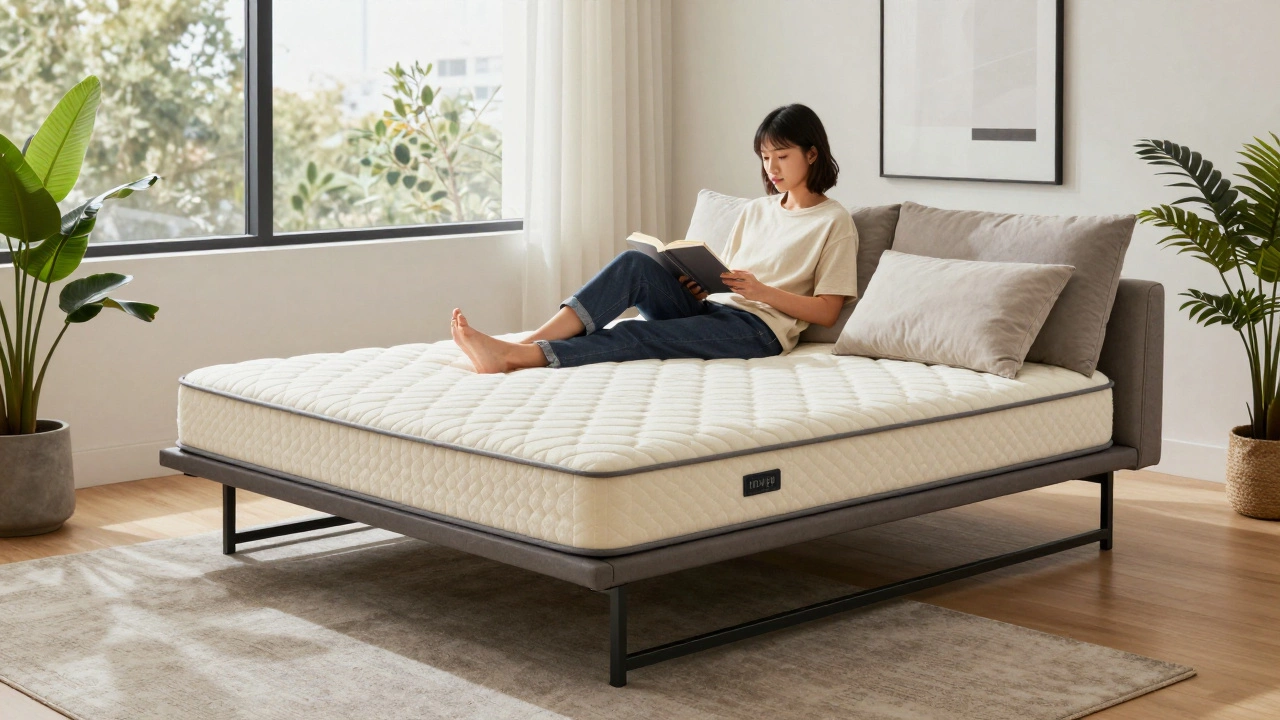
Real-world test: Sit on a sofa bed for 10 minutes. If your lower back starts to ache, or your legs feel unsupported, it’s not right. If you forget you’re on a sofa bed and start reading or watching TV? That’s the sign of a good one.
How do sofa beds compare to regular sofas?
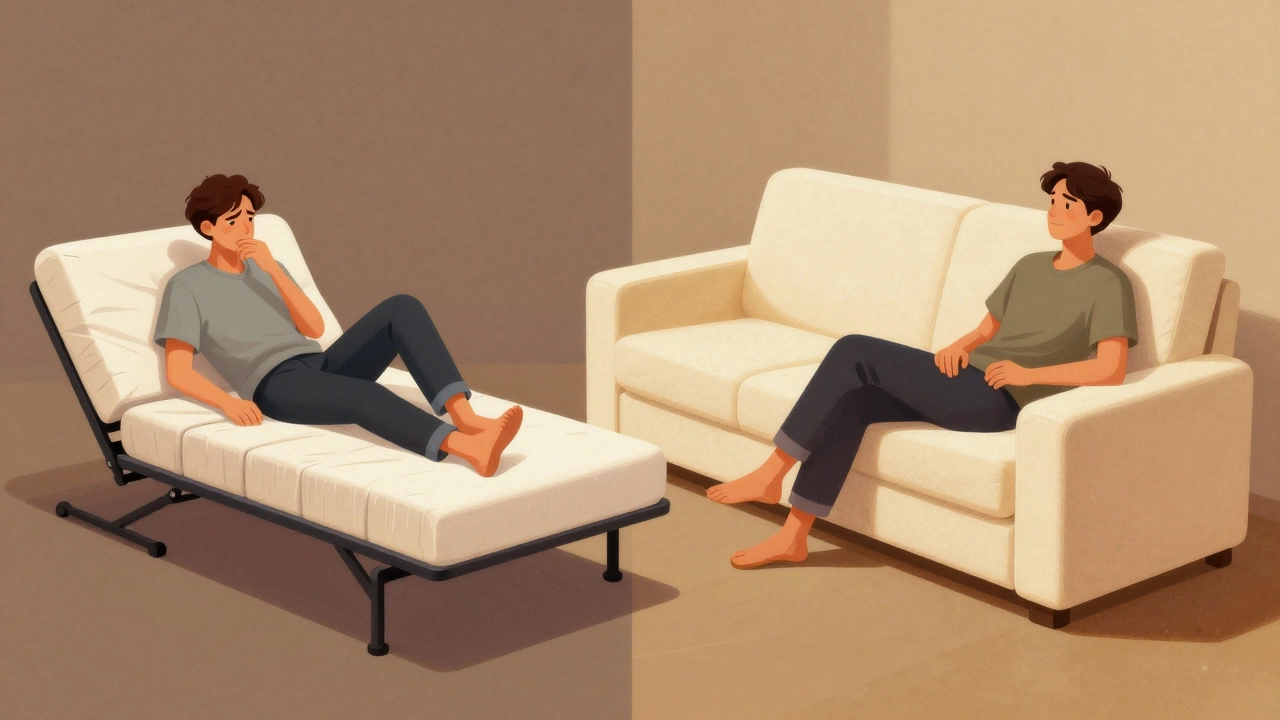
Let’s be honest - a dedicated sofa will always win on pure sitting comfort. But that’s not the whole story. Sofa beds aren’t meant to replace sofas. They’re meant to double as one.
Here’s how they stack up:
| Feature | Sofa Bed | Regular Sofa |
|---|---|---|
| Cushion density | 25-35 kg/m³ | 30-45 kg/m³ |
| Back support | Often lower, less contouring | Higher, better lumbar support |
| Seat depth | Shallower (50-55 cm) | Deeper (55-65 cm) |
| Frame rigidity | Varies - check steel vs. particleboard | Consistently sturdy |
| Long-term comfort | Good models last 5-8 years | Typically 8-12 years |
Bottom line: A high-quality sofa bed can come within 80% of a regular sofa’s comfort. But if you’re looking for luxury lounging, you’ll still want a dedicated sofa. The sofa bed’s job is to be a smart, space-saving compromise - not a luxury seat.
What to avoid when buying a sofa bed
Not all sofa beds are created equal. Here’s what to skip:
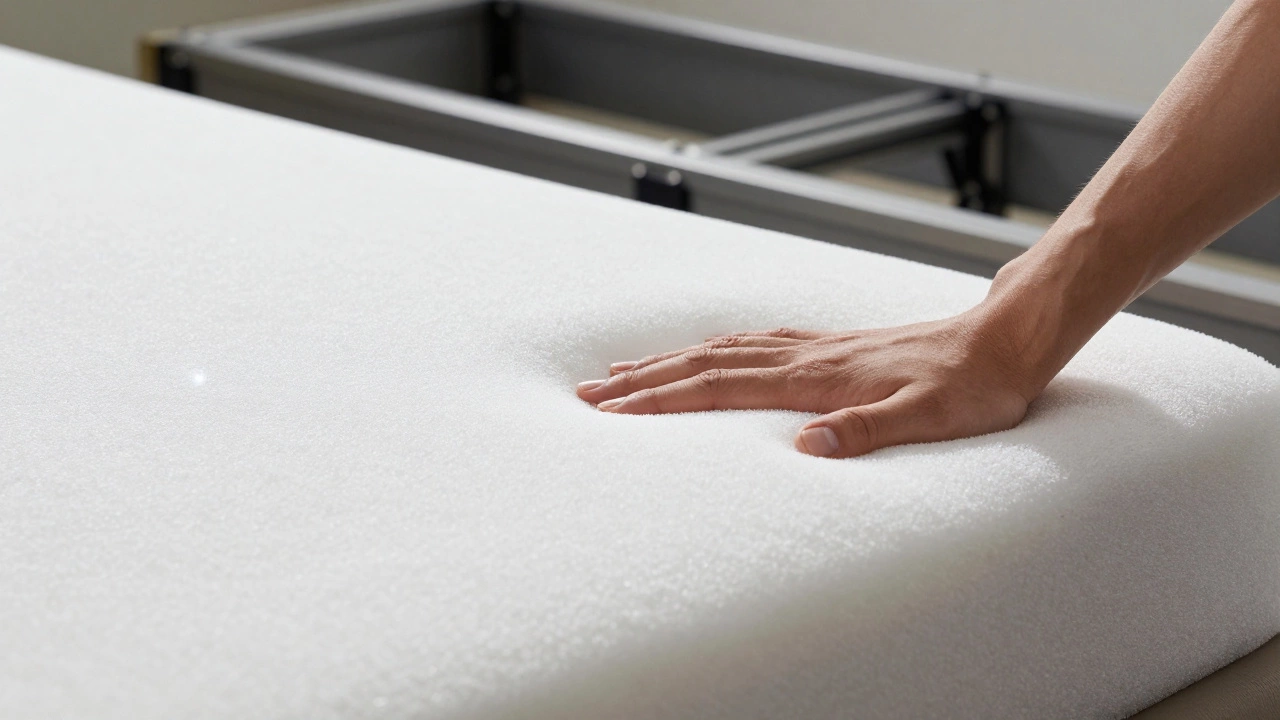
- Memory foam mattresses - They’re great for sleeping, but they make sitting stiff and slow to bounce back. You’ll feel stuck.
- Thin cushions under 8cm - These flatten in weeks. You’ll be sitting on the frame before you know it.
- Plastic or particleboard frames - They crack under weight. If you press on the side and it bends, walk away.
- No test-in-store option - If the store won’t let you sit on it, they’re hiding something.
- Overly cheap models under $500 - You get what you pay for. A good sofa bed starts around $800 in Australia.
Pro tip: Look for models with removable, washable covers. Dust, spills, and pet hair happen. If you can’t clean it, you’ll hate it in six months.
Real-life examples from Melbourne homes
In Melbourne, where space is tight and second bedrooms are rare, sofa beds are everywhere. A friend in Fitzroy uses a Lövhult a popular IKEA sofa bed model with a 12cm high-resilience foam mattress and steel frame in her studio. She says: "I sit on it daily. My partner sleeps on it twice a week. It’s never felt like a chore. I even had guests say it was more comfortable than their own couch."
Another family in St Kilda bought a Ashley Furniture’s "Harbor" sofa bed a mid-range model with pocket springs and a 15cm mattress, designed for daily use. They used it for six years. The cushions are still firm. The frame hasn’t squeaked. They say it’s the best furniture purchase they’ve ever made.
On the flip side, a client in Richmond bought a $399 sofa bed from a big-box store. Within three months, the foam compressed, the mechanism jammed, and the cover tore. She replaced it with a $1,200 model - and never looked back.
Who should skip sofa beds?
Not everyone needs one. Here’s who’s better off without:
- You sit for hours daily - If you work from home, binge-watch TV, or read for long stretches, a dedicated sofa is worth the space.
- You’re over 90kg - Heavier users need reinforced frames and high-density foam. Most budget models can’t handle it.
- You have back problems - A sofa bed rarely offers enough lumbar support. Try a recliner instead.
- You want style over function - If your living room is a design showcase, a sofa bed might clash. Look for a modular sofa with a hidden pull-out instead.
Final verdict: Are sofa beds uncomfortable to sit on?
No - not if you pick the right one.
Sofa beds aren’t perfect. But they’ve come a long way. Modern designs use better materials, smarter mechanics, and thoughtful engineering. The uncomfortable ones? They’re still out there - but they’re the exception, not the rule.
If you need the flexibility of a bed without giving up your living room space, a quality sofa bed is a smart, practical choice. Just don’t buy the cheapest one. Test it. Sit on it. Live with it for 10 minutes. If it feels like a couch, you’ve found your match.
Are sofa beds good for daily sitting?
Yes - but only if they’re built for it. Look for models with high-density foam (30kg/m³+), steel frames, and mattresses over 10cm thick. Avoid memory foam and thin cushions. Daily use is fine if you invest in quality.
How long do sofa beds last?
A well-made sofa bed lasts 5 to 8 years with regular use. Budget models under $600 often wear out in 2-3 years. The frame, mattress, and mechanism are the three key parts that determine lifespan. Replace the mattress if it sags, and lubricate the mechanism yearly.
Can you sleep on a sofa bed every night?
Technically yes, but it’s not ideal. Sofa beds are designed for occasional use. For nightly sleeping, a proper mattress on a bed frame is better for posture and comfort. If you must use one daily, choose a model with a 15cm pocket-spring mattress and a sturdy frame.
What’s the best material for sofa bed cushions?
High-resilience foam (HR foam) is the best. It bounces back quickly, holds its shape, and doesn’t flatten like low-density foam. Avoid memory foam for seating - it’s too slow to recover. Some high-end models combine HR foam with down feathers for extra softness.
Do sofa beds need special maintenance?
Yes. Flip the cushions every 2-3 months to prevent uneven wear. Vacuum the frame and mechanism yearly to remove dust. Lubricate the moving parts with silicone spray every 6 months. If the cover is removable, wash it every 3-6 months to keep it fresh.